- Now Frolic
- Posts
- The Town Steeped in Tradition: Oberammergau
The Town Steeped in Tradition: Oberammergau
A Place Where Tourists Descend Every Ten Years for a Nearly 400-Year-Old Tradition

Amanda Finn
February 21, 2026

Author’s Note: This column is dedicated to my dear friend Scotty, who recently passed away, whose friendship forever changed my life. He would undoubtedly chuckle at this sentiment in relation to writing about Oberammergau and probably roll his eyes at my quoting Goethe below.

Ammergau Lodge in Oberammergau (Amanda Finn)
Death is a commingling of eternity with time; in the death of a good man, eternity is seen looking through time.
It began with the bubonic plague. At least, that’s how the legend goes. The bubonic plague shrouded Bavaria in destruction in the early to mid 1600s. When it came to the town of Oberammergau in 1633, half of the townspeople died. According to legend, that is when the surviving townsfolk vowed to God that they would reenact the story of Jesus Christ’s life, crucifixion, and resurrection every 10 years if they were spared from the deadly plague.
Church records indicate that there were no other plague-related deaths after the oath was sworn.
The people of Oberammergau have kept to their word. With a few exceptions, ironically including 2020 due to the COVID-19 pandemic, the community has gathered to perform this play every decade since the first performance in 1634. When they haven’t been able to do it at exactly the ten-year mark, they reschedule the performance for as soon as possible after that. At the time of the vow, fewer than 100 living souls called the town home. Now, about 5,000 people live there, and yet, the performance remains a community-wide phenomenon.

Merch found throughout the village highlights the importance of the decennial play. (Amanda Finn)
Traveling to Oberammergau during a Passionsspiele or Passion Play year resembles a pilgrimage. This fabled story, told by at least 500 people sharing a stage during the run of a performance, is enough to elicit hundreds of thousands of travelers to the picturesque town. In fact, 2022’s iteration drew more than 400,000 people to this small Bavarian town to witness the spectacle. Everywhere you turn, there is a reminder of the show’s importance. From merchandise to the throngs of tourists, there is no escaping it. The Oberammergau Museum was surrounded by preserved costumes from the 2010 Passionsspiele. Even the shorn hair from actors from the last iteration of the play was on display as art pieces at the museum’s play exhibit. The fact is, traveling anywhere in the entire town is almost like being backstage at the playhouse. Any person you run into could be a crew member, cast member, or performing musician, or come from a long line of Passionsspiele players.
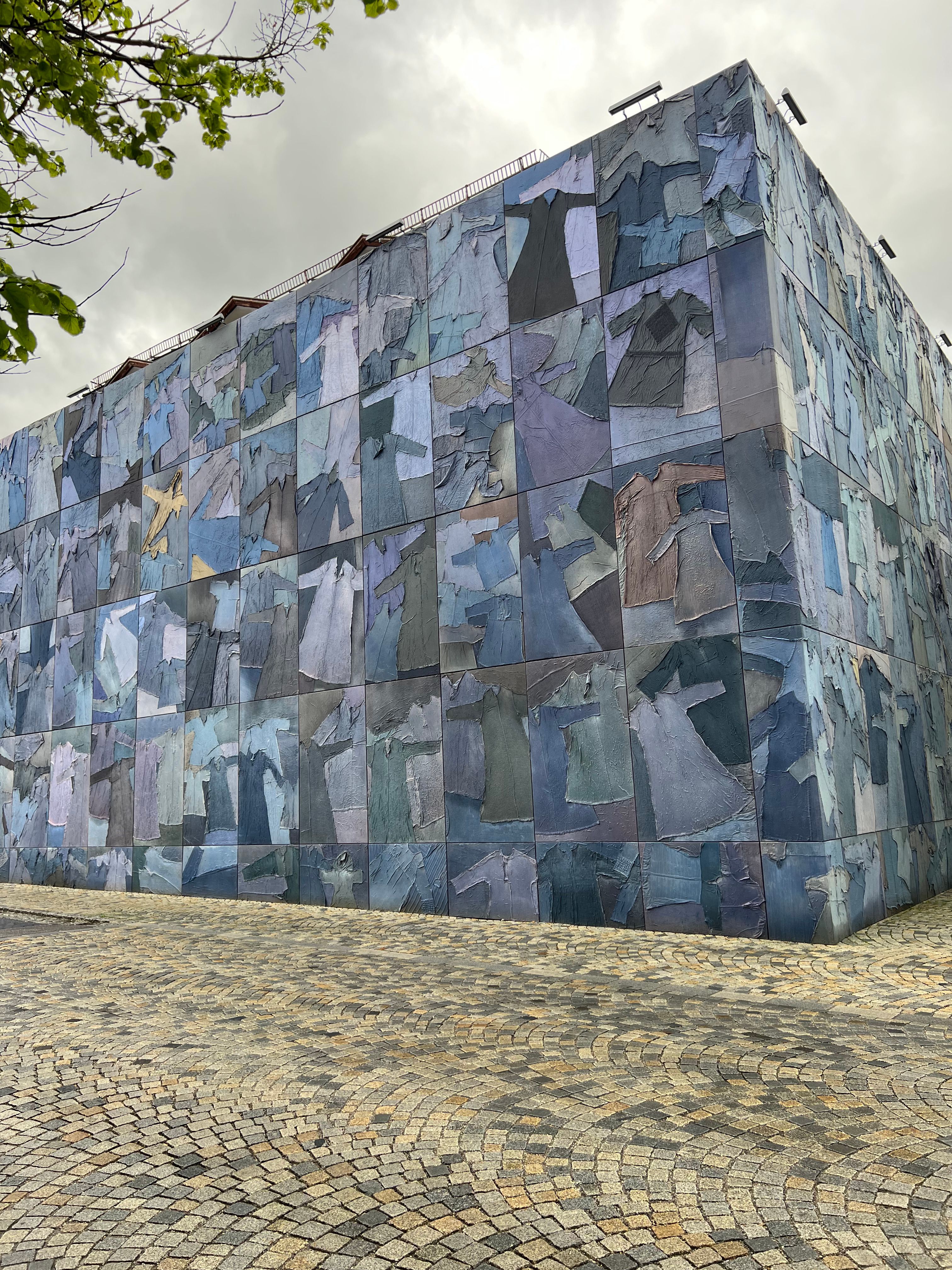
Oberammergau Museum covered in 2010 Passion Play costumes (Amanda Finn)
As soon as I heard about this play in 2018, I was enraptured. More than 2,000 people come together to make this over five-hour-long play a reality for nearly half a year. Men grow out their hair and beards for 18 months, citizens become actors, and entire families take the stage for a generation-spanning tradition. The town has become synonymous with this tradition. So much so that my theater colleagues immediately knew what had me so fascinated about Oberammergau — particularly my friend Scotty. He was quick to send me research from his dear friend, mentor, and fellow journalist Glenn Loney, and even his copy of the playbook from the 2010 performance.
Over the course of roughly five and a half hours, the audience witnesses sixteen acts depicting key moments of Christ’s life. The entire performance is in German – specifically Bavarian German – which even some German speakers around me couldn’t quite understand. Surrounded by audience members from all over the globe, the language barrier made little difference. My months of Duolingo German did me almost no good (sorry, Duo), and it didn’t matter. My eyes were locked, my heart was set, and every single moment that played out on that stage was everything I had imagined. After spending four years researching the work, I was there.

Oberammergau’s Passionsspiele theater (Haggerty Photography)
Glancing down at my follow-along book only periodically, the Bavarian German dialect washed over me like a soft blanket as though my lineage of Germanic ancestors were surrounding me, helping me understand even when I wasn’t sure of the words. Sure, my Catholic upbringing and several years of performing in my own church’s Passion Play were probably the main reasons for my understanding, but I digress.
Why am I telling you all this? Because Oberammergau is not just a destination, a beautiful place I long to return to – it is a testament to change. You see, this engrossing, centuries-old tradition has had its problems. Before drastic changes were made to the play’s script and overall production in 1990, 2000, and onward, the play was condemned for its anti-Semitic elements. Rather than assert the importance of tradition or eliminate the show, director Christian Stückl, dramaturgist Otto Huber, and others worked diligently (and continue to do so) with religious scholars to keep the play alive — without bigotry.
One of the most moving changes is that Christ, his disciples, and other characters in the performance pray in Hebrew. Even the blessing during the Last Supper scene is in Hebrew. None of that would have been possible if the artists behind this tradition had not done the work to make the changes needed. If they had shrugged it off or given up altogether, the Passionsspiele may have died. The tradition that makes arts enthusiasts’ ears perk up when I say “Oberammergau” would have vanished, and a tiny mountain town that looks like the setting of a Disney fairytale would never have been on my radar.
That’s when I realized travel exists much in the same way. We experience a place in the here and now — even if it is thousands of years old.
Visiting Oberammergau for this production was a much-needed revelation that if theater doesn’t evolve, it may not survive for the next generation (or twelve) to enjoy. That’s when I realized travel exists much in the same way. We experience a place in the here and now — even if it is thousands of years old. My impression of seeing The Great Wall of China in 2019 is inherently different from anyone else's and would even probably change in some way for my 2026 self.
Anywhere on earth we go is informed by everyone who came before us, as well as everyone who is there now. That’s why travel (and art) changes us so drastically; it meets us where we are at the time. I may never have even heard of the Passionsspiele if it weren’t for a single slide in a tourism presentation. No one else in the room seemed gripped by that in the way I was. The tale of an entire town that comes together every ten years to tell a story. A story that, like the town, has changed over time without letting go of the tradition.
The moral of my Sunday school-adjacent story is to follow that rabbit hole. Find your own Oberammergau, a place that you can’t stop thinking about. When you hear about something that sounds interesting, run with it. Even if it takes you years to get there, when you arrive, your life might change forever. Oberammergau reminded me of the importance of theater as a living art form, one that changes as the world does.
Health That Fits Real Life

Most of us don’t need another routine. We just need something that works. AG1 Next Gen supports gut health, fills common nutrient gaps, and helps maintain steady energy with one daily scoop. Simple, fast, and easy to stick with. Start with AG1 today and get bonus Travel Packs in your Welcome Kit.
Smarter news. Fewer yawns

Business news takes itself way too seriously.
Morning Brew doesn’t.
Morning Brew delivers a smart, skimmable email newsletter on the day’s must-know business news — plus games that make sticking around a little more fun. Think crosswords, quizzes, and quick breaks that turn staying informed into something you actually look forward to.
Join over 4 million professionals reading Morning Brew for free. And walk away knowing more than you did five minutes ago.
Amanda Finn (she/they) is an award-winning arts, lifestyle, and travel writer. Based in Chicago, they have made it their mission to get to know the world one journey or show at a time. So far, they have been to 21 countries and 28 states with no plans to stop anytime soon. You can find some of Amanda's other work in publications like the Chicago Reader, ViaTravelers, American Theatre Magazine, Yahoo, and HuffPost.
Besides exploring the world, Amanda is also a bonafide Disney Parks fan. So far, they have been to four of the six parks around the world: Disneyland, Walt Disney World, Disneyland Paris, and Disneyland Hong Kong.
Through their column at Now Frolic, Amanda wants to bring authenticity and cultural awareness back into the travel space. In a landscape rife with listicles, outsourced material, and AI generation, their hope is to reintroduce readers to the genuine article. Each month, you can read about a new destination, learning about what makes that place special or how we, as travelers, can see the world in a whole new light.